
The Power of Touch: Why Physical Contact Matters So Much – The Science Behind It
Author: Valentina Salaviova - Last updated: 15 August 2026📌 In brief: Touch is far more than a mechanical act. When the skin is touched gently and slowly, the brain activates what are known as the C-tactile nerve fibres: the bonding hormone oxytocin is released, stress hormones are broken down, breathing and heartbeat slow. The body relaxes – we calm down and feel good. This is why physical contact is now regarded as fundamental to health and well-being.
Loving massage, touch and embraces are today associated with a whole range of positive effects. More and more studies make it clear: physical contact is fundamental. From the earliest development of a child, through the social behaviour of adults, to general health or team sport – there is hardly an area of life on which touch has no influence.
How do we know today how important touch is?
It was not always understood that touch is more than a mechanical act. Right up until the 1950s, psychologists even advised young mothers to reduce physical contact with their babies to feeding times. Cuddling, stroking and comforting were considered damaging to development – supposedly because they made children moody and spoilt. Strict physical punishment, by contrast, was expressly recommended.

The behavioural researcher Harry Harlow was, in the 1950s, one of the first to investigate the significance of touch and physical affection systematically – through experiments with rhesus monkeys. Even though Harlow's experiments are, from today's perspective, unethical and highly questionable, at the time they showed unmistakably that physical contact is essential to healthy psychological and physical development.
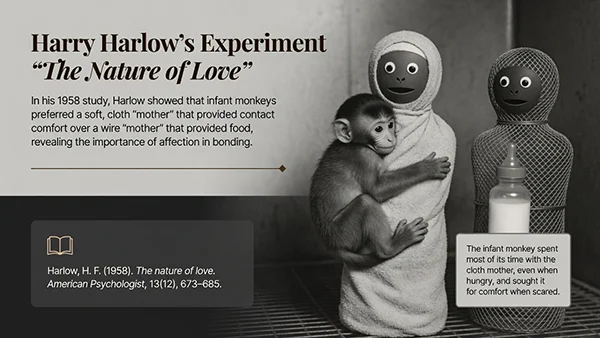
His conclusion in the 1958 paper "The Nature of Love" was blunt: what the infant monkeys sought in their surrogate mother was not food but contact – closeness mattered more than milk.
Since then, research has taken a growing interest in the effects of touch – with fascinating results.
Why does touch feel so good?
The answer lies in the reactions that unfold inside our bodies.
Our skin is the boundary between the body and the outside world – our largest organ, equipped with millions of receptors. With them we sense cold and warmth, textures and pressure, but also touch and tenderness. Along the nerve pathways, the signals from the skin receptors are conducted directly to the brain.
Here is the interesting part: it is not only the facts that are transmitted – the place and kind of touch. An emotional evaluation also takes place: is this touch pleasant or unpleasant, positive or negative?

When the brain evaluates a touch as positive and pleasant – as with gentle, slow stroking – what are known as the C-tactile nerve fibres are activated. A Swedish research group was able to demonstrate this connection directly: in their study in Nature Neuroscience, these fibres responded most strongly to stroking at a moderate speed of roughly one to ten centimetres per second – and it was precisely that speed which the participants rated as the most pleasant. Almost exactly the tempo, in other words, at which we instinctively stroke someone we are fond of.
This activation leads the brain to release the bonding hormone oxytocin. At the same time, sensitivity to endorphins, the body's own messengers of happiness, increases. Stress hormones are broken down, breathing and heartbeat slow. The body relaxes, we calm down and we feel happy. A research team at the University of North Carolina found this pattern in couples too: those with a warmer, more supportive relationship showed higher oxytocin levels before and after a period of affectionate contact – and, in women, lower blood pressure and lower levels of the stress hormone noradrenaline.
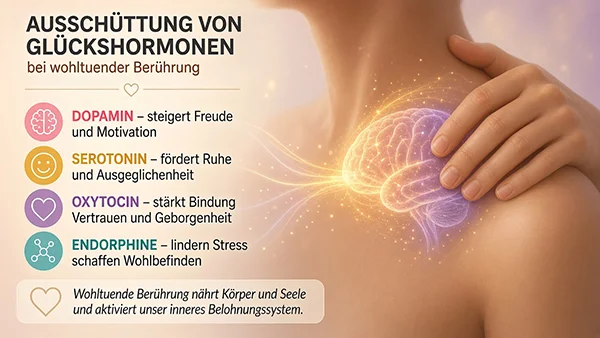
In this way, soothing touch can have an immediate positive influence on our emotional state – and this is exactly the principle that every mindful massage draws on.
Touch can do still more
The largest evaluation to date comes from a research team in Bochum, Essen and Amsterdam. For their meta-analysis in Nature Human Behaviour, the researchers pooled 137 studies with almost 13,000 participants – and found that touch measurably reduces pain, depressive feelings and anxiety. Notably, people who were already dealing with physical or mental health problems benefited even more clearly than healthy participants.
The power of touch shows itself in everyday life too. In a study by Carnegie Mellon University, more than 400 volunteers were deliberately exposed to a cold virus after their daily embraces had been recorded over two weeks. The result: hugs cushioned the effect of stress on the immune system – and those who had been hugged more often showed milder symptoms when they did fall ill.

Even short moments of contact leave a trace. In an experiment at the University of North Carolina, couples held hands for ten minutes and then embraced for twenty seconds before facing a stressful task. Compared with a group without any physical contact, their blood pressure and heart rate rose distinctly less under the strain – a hint that regular physical closeness may also benefit the cardiovascular system over the longer term.
❗Please note: Touch and massage are no substitute for medical treatment. Health complaints belong in a doctor's hands – but mindful physical contact can support well-being wonderfully.
Touch deprivation: when physical contact is missing from daily life
As fundamental as touch is, it has become just as rare in modern everyday life. Full diaries, screens, physical distance from family, single households – many people go for weeks with barely any conscious, soothing physical contact. Specialists speak of touch deprivation, or "skin hunger".
The possible consequences: heightened tension, inner restlessness, the vague feeling of not being quite at home in yourself. The body simply isn't getting what it was built for – because the need for touch is not a luxury but a basic need, one that accompanies us from the first minute of life.

The good news: touch can be consciously brought back into your life. Embraces among friends, cuddling with a partner – or a professional massage, in which the body receives mindful, soothing touch for a whole hour or longer.

Mindful massage: experiencing the power of touch consciously
A professional massage is one of the most beautiful and most intense ways to experience the power of touch: warm oil, slow flowing movements, a protected space free of expectation – and a whole stretch of time that belongs to touch alone.

Precisely those slow, gentle stroking touches to which the C-tactile nerve fibres respond most strongly stand at the centre of sensual massages: they unite deep relaxation with conscious, mindful bodily awareness. Anyone seeking the ritual, meditative path will find in tantric massage perhaps the most holistic form of mindful touch. And because touch nourishes relationships too, a massage for couples is a wonderful way to experience shared closeness anew.
Let yourself be touched regularly – and live healthily and happily!
At Spa Sensuel in Dielsdorf – near Zurich, discreet and stylish – we devote ourselves to exactly this art: touch that does you good. If your curiosity is awakened, you'll find all our massages and prices on our website. For beginners we recommend our guide to the first erotic massage.
The power of touch in questions and answers
Why is touch so important for human beings?
Touch is a basic need that accompanies us from birth. Positive physical contact encourages the release of the bonding hormone oxytocin, breaks down stress hormones and supports both emotional and physical development – research has been showing this ever more clearly since the 1950s.
What happens in the body during a pleasant touch?
Gentle, slow stroking activates the skin's C-tactile nerve fibres. The brain releases oxytocin, sensitivity to endorphins rises, stress hormones are broken down, breathing and heartbeat slow – the body relaxes noticeably.
What is touch deprivation?
Touch deprivation describes the absence of regular, soothing physical contact in everyday life. Possible signs are heightened tension, inner restlessness and the feeling of not being quite at home in yourself. Conscious touch – through embraces or massage, for instance – can help to meet this basic need again.
Can a massage intensify the effect of touch?
Yes. A professional massage concentrates exactly the kind of touch to which the body responds most strongly: slow, warm, mindful and sustained over a longer period. Many people experience a depth of relaxation that is hard to reach in daily life.
How often should you let yourself be touched?
There is no fixed rule – but touch works best when it happens regularly. Whether daily embraces, weekly cuddling or a monthly massage: what matters is that soothing physical contact becomes a firm part of your life.
Sources
- Harlow, H. F. (1958): The Nature of Love. American Psychologist 13, 673–685.
- Löken, L. S. et al. (2009): Coding of pleasant touch by unmyelinated afferents in humans. Nature Neuroscience 12, 547–548.
- Grewen, K. M. et al. (2003): Warm partner contact is related to lower cardiovascular reactivity. Behavioral Medicine 29(3), 123–130.
- Grewen, K. M. et al. (2005): Effects of partner support on resting oxytocin, cortisol, norepinephrine, and blood pressure before and after warm partner contact. Psychosomatic Medicine 67(4), 531–538.
- Cohen, S. et al. (2015): Does hugging provide stress-buffering social support? Psychological Science 26(2), 135–147.
- Packheiser, J. et al. (2024): A systematic review and multivariate meta-analysis of the physical and mental health benefits of touch interventions. Nature Human Behaviour 8, 1088–1107.

Written by
Valentina Salaviova
Owner and host at Spa Sensuel. An expert in sensual massage with a deep background in body psychotherapy and tantric work. Today, Valentina embodies what Spa Sensuel stands for: mindfully lived sensuality and the highest standards of quality.
© Spa Sensuel Massages. All content in this article, in particular text and images, is protected by copyright. Any reproduction or distribution requires written consent.